Apologies for the long silence. It’s been a very hectic past few months, between working on multiple research projects and papers, applying to graduate schools, beginning a senior thesis, and increased involvement in Divest Harvard, where I’ve been coordinating the alumni wing of the campaign. I hope to have more to say about the first item in the next few weeks. In the meantime, here’s a talk that I gave that relates to the last.
I recently attended the 30th anniversary event of the Center for Excellence in Education, as an alum of the Research Science Institute, which was my first experience being a (however small) part of a mathematical community, and incidentally where I began blogging about mathematics. CEE offered attending alumni the chance to present short talks about topics of their choice. My talk, whose title is that of this post, is included below; the talk was also videotaped, and the video has been posted online. Here is the text.
It is great to be here. I was RSI ’09, and it was one of the best summers of my life. I would like to thank the Center for Excellence in Education for making that experience possible, and for organizing today’s very enjoyable events.
Like most of you here today, I am a scientist — or rather, a scientist-in-training. I am a scientist because I think discovering new things is stimulating and exciting. Yet I want to make the case that making discoveries is not enough for the world we live in — and that we have an ethical obligation to do more, to transcend the traditional scientific position of neutrality.
Much has been said about the ethics of science, ranging from physicists’ work on nuclear weapons to the treatment of animals. But the question we face today isn’t a question about the ethics of science itself: it’s a question about what happens when science speaks and yet no one listens. How can science make itself heard? And should it?
As you may surmise, I am referring to the climate crisis. Decades after scientists have understood the role of fossil fuels in the warming of our planet, the world’s annual carbon dioxide emissions continue their steady growth. I know everyone here has heard a lecture about polar bears at some point in their lives. I don’t wish to repeat that — because it’s too abstract, and it overlooks the absolutely fundamental human rights dimensions of the crisis. Climate change, simply put, threatens hundreds of millions of lives, and my generation’s future. I believe that it represents one of the critical issues that future generations will judge us on — just as we judge previous generations by their positions on civil rights, or on slavery.
My generation is obviously not the first to take climate change seriously. Many people have been valiantly fighting climate change for decades, developing cleaner energy technologies and lobbying our political system — some of you may be among them. But these efforts have been insufficient, and for a clear reason: powerful forces stand in the way. And foremost among those forces is the fossil fuel industry.
Why is that? According to the IPCC and others, the world has a “carbon budget,” comprising some 565 gigatons of carbon dioxide that can be burned to have a 80% chance of at most two degrees warming, the upper limit that the international community has set for global warming. This “carbon budget” leaves us with a limited time window, roughly thirty years at our present rate, in which to transition to a low-carbon future. It’s no secret that the world is not on track to make that transition. This is, in fact, a huge understatement. The proven reserves of the world’s fossil fuel companies amount to 2,795 gigatons. At this point, there is no expectation — in the markets or otherwise — that they won’t all be burned, leaving almost no chance for a stable future. It’s clear that no industry wants to have to write off the vast majority of their assets — which makes the motivations for fossil fuel industry’s well-documented campaigns to block climate change legislation all the more evident.
That’s why thousands of students at universities across the country, and across the world, have been calling on their schools to divest from fossil fuel companies — along with activists at numerous local governments and religious institutions. I’ve been proud to have been one of them, through the Divest Harvard campaign. Since last fall, we’ve been putting pressure on our administration to divest by cultivating a groundswell of support from students, faculty, and alumni. We’ve had considerable success: for example, in a referendum last fall, 72\% of Harvard undergraduates voted for a resolution calling for divestment from fossil fuels. Nationally, so far, seven universities have divested, along with several religious institutions and local governments. We don’t expect this to be an easy or quick victory, but then again, climate change is complicated.
What is divestment? Divestment is the removal of one’s investments from a particular firm or industry, often for ethical reasons. As a tool for social change, it has illustrious precedent. After pressure from students and faculty, numerous universities, notably UC Berkeley, divested from South Africa in the 1980s, in addition to pension funds and state governments. This has been credited with helping to end the apartheid regime.
All the same, many of you are probably wondering about the connection between divestment and stopping the climate crisis. It’s admittedly true that divestment itself is no substitute for better solar panels and better policies. Divestment is, instead a tool, to stigmatize an industry whose very business model necessitates catastrophic warming. And as a tool it has enormous promise. A recent Oxford University study showed that previous divestment campaigns, such as divestment from apartheid South Africa, were highly effective in bringing about necessary restrictive legislation. That report, moreover, found concluded that fossil fuel divestment is growing much faster than any of the previous campaigns analyzed.
There are many questions that have been raised, by people generally in support of action on climate change, on divestment. It is not, after all, the type of technique traditionally used by the environmental movement. Classical environmentalism has focused on individual responsibility and moral suasion. Important as that is, it suffers from a fatal flaw: there is no way putting on a sweater can bring about a political solution on climate change. And we really do need a political solution on the climate crisis. The challenge is, after all, to convince a hugely profitable industry to write off the majority of its assets.
The most common counterargument against divestment observes that we are all complicit in the world’s dependence on fossil fuels. Nonetheless, I believe that it is the fossil fuel industry that has made it impossible for us not to be complicit: it has prevented the political action that would allow us meaningful alternatives. Given the size of its reserves, this was only rational on their part.
But another common counterargument, which we often hear both from scientists and researchers and from university administrators, states a position of neutrality. Scientists and researchers, especially those who study climate change, are reluctant to do anything that might be seen as politicizing their work. After all, we’ve been told that it’s our goal to make the discoveries, not to legislate.
Money managers claim that endowments and pension funds should maintain a neutrality to best ensure returns.
The problem with that is that climate change is an existential threat. It is not a political issue, and wanting a stable future is not a special interest. There is no neutral ground for us, as scientists, and there is no neutral ground for institutions — like our universities — that will be directly affected by climate change.
My generation is not, obviously, the first to understand the seriousness of the climate crisis. But members of my generation, at least the ones I’ve talked to, have a certain urgency in confronting the climate crisis — an intensity matched, perhaps, by the seriousness of the problem. Members of my generation tend to see climate change as more than a technical fix to be solved with engineering wizardry, but instead as a profound ethical issue. Though we didn’t cause the problem, we are, after all, the ones who will inherit a warming planet. In calling for divestment, our hope is that we can bring about a world that decides to keep four-fifth’s of the fossil fuel reserves in the ground.
As scientists and scientists-in-training, I believe we have a special obligation to confront the climate crisis. But I do not believe neutral research and education, the role that we and our universities traditionally play, can suffice: all the solar energy research in the world cannot help if we elect to keep burning coal anyway. I believe that there is a place for grassroots social activism on this, in which we can play a role.
The chasm between political organizing and scientific research is often vast. But the example of James Hansen, among others, suggests that it may be bridged at the highest levels of both. I hope many of you will consider bridging it yourself, whether by telling your alma mater that you won’t donate until it divests or by writing a letter to your senator explaining why you support a carbon tax.
Like most of you, I went to RSI because I wanted to solve hard problems. This may be the hardest problem the world has ever seen. I hope we can work together on it. Thank you.
 ; as we’ll see, the Fano scheme is 27 reduced points, and the count can be made with a little calculation on the Grassmannian. Although the calculation is elementary, I found it worthwhile to work carefully through it, not only for its intrinsic interest but also as motivation for the study of intersection theory on moduli spaces in general. Once again, most of this material is from Eisenbud-Harris’s draft book
  is a smooth surface, imbedded in some projective space, and consider the scheme
  of lines in
  .
. in
in  . In this case, the normal sheaf
  is actually a vector bundle of normal vector fields, given by the adjunction formula
 and has a well-defined degree. This degree is in fact the self-intersection
  of
of  be a subvariety (or scheme). A natural question one might ask is whether
  contains lines, or more generally, planes
  and, if so, what the family of such look like. For example, if
  is a nonsingular quadric surface, then
  has two families of lines (or “rulings”) that sweep out
 via the Segre embedding. For a nonsingular cubic surface in
  of
of  -planes in
  (i.e.,
  -dimensional subspaces of
  ) that parametrizes those
  ; such a subscheme is necessarily a linear subspace.
 of
of  parametrizing subschemes
  whose Hilbert polynomial is
  be a smooth degree
  curve. Then there is a dual curve
 , to the (projectivized) tangent line at
  . Such lines live in the dual projective space
  of lines in
  . We will denote the image by
  ; it is another irreducible curve, birational to
  .
. fails to be one-to-one. In fact, if
  will have only nodal and cuspidal singularities, and we we will be able to work out the degree of
  bitangents on a smooth plane quartic. In other words, of the
  theta characteristics, exactly
  such that the intersection
  is a divisor of the form
  for
for  points, not necessarily distinct. So a line intersecting
  flex lines. This is a special case of the
  . A theta characteristic on
  , i.e. a line bundle
  such that
 , which is isomorphic to
  .
. . On a framed manifolds, there is a canonical choice of quadratic refinement on the middle-dimensional mod
  homology (with its intersection pairing), which gives an important invariant of the framed manifold known as the Kervaire invariant. (See for instance
  on the theta characteristics is precisely this invariant. In other words, theta characteristics give a purely algebraic (valid in all characteristics, at least
  ) approach to the Kervaire invariant, for surfaces!
 is a two-fold cover: that is,
  of the cover
  , the hyperelliptic involution. That is, every genus two curve has a nontrivial automorphism group. This is in contrast to the situation for higher genus: the general genus
  curve has no automorphisms.
 . There is no further monodromy data to give for the cover
  , since it is a two-fold cover; it follows that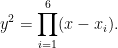
 by the homogenized form of the above equation,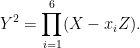
 , modulo automorphisms of
  , and quotients by the action of
  . In fact, this is a description of the coarse moduli space of genus two curves: that is, it is a variety
  whose complex points parametrize precisely genus two curves, and which is “topologized” such that any family of genus two curves over a base
  gives a map
  . Moreover,
  , which rigidifies most of the action of
  modulo action of the group
  consisting of automorphisms of
 .
. as the
  as vary) such that every genus two curve occurs in the family (albeit more than once).
 , the variety
  parametrizing genus
  curves is known to be of general type, by a theorem of Harris and Mumford.

 is the Steenrod algebra and
  is the 64-dimensional subalgebra generated by
  and
and  . This computation means that the
 page of the ASS can be computed, although the result is quite complicated.
  in this paper is based on a certain eight-cell (2-local) complex
  , with the property that
 is a quotient of the classical
  is a complex-orientable ring spectrum, so that computations with it (instead of
  ), and one finds that it is cyclic over the Steenrod algebra. One can then try to “descend” to the cohomology of
  –
– -theory. As a ring spectrum,
  : the formal multiplicative group. Along with
  , the formal multiplicative group
  (over a topological space
 ![\displaystyle c_1( \mathcal{L}) = [\mathcal{L}] - [\mathbf{1}];](https://s0.wp.com/latex.php?latex=%5Cdisplaystyle+c_1%28+%5Cmathcal%7BL%7D%29+%3D+%5B%5Cmathcal%7BL%7D%5D+-+%5B%5Cmathbf%7B1%7D%5D%3B+&bg=ffffff&fg=000000&s=0&c=20201002)
 (modulo a normalization) to define.
 to the moduli stack of formal groups
  , is a flat morphism.
  be a (smooth) curve in projective space of some degree
  of degree
  of dimension
  such that the sections in
  have no common zeros in
 ![{I \subset k[x_0, \dots, x_r]}](https://s0.wp.com/latex.php?latex=%7BI+%5Csubset+k%5Bx_0%2C+%5Cdots%2C+x_r%5D%7D&bg=ffffff&fg=000000&s=0&c=20201002) (consisting of all homogeneous polynomials whose vanishing locus contains
(consisting of all homogeneous polynomials whose vanishing locus contains ![\displaystyle S = k[x_0, \dots, x_r]/I;](https://s0.wp.com/latex.php?latex=%5Cdisplaystyle+S+%3D+k%5Bx_0%2C+%5Cdots%2C+x_r%5D%2FI%3B+&bg=ffffff&fg=000000&s=0&c=20201002)
![{k[x_0, \dots, x_r] = \bigoplus_{n = 0}^\infty H^0( \mathbb{P}^r, \mathcal{O}_{\mathbb{P}^r}(n))}](https://s0.wp.com/latex.php?latex=%7Bk%5Bx_0%2C+%5Cdots%2C+x_r%5D+%3D+%5Cbigoplus_%7Bn+%3D+0%7D%5E%5Cinfty+H%5E0%28+%5Cmathbb%7BP%7D%5Er%2C+%5Cmathcal%7BO%7D_%7B%5Cmathbb%7BP%7D%5Er%7D%28n%29%29%7D&bg=ffffff&fg=000000&s=0&c=20201002) in
in  . But that in turn suggests another natural ring associated to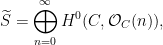
 for line bundles
  on
on 
 is surjective in all large dimensions.
 is an isomorphism.

 Climbing Mount Bourbaki